
Layer 01, Distributed Cognitive Architecture
The Hall of Shoulders
193 individual thinker-brains, including a new cohort of historical space pioneers and modern space thinkers. Many minds. One Collegium. Each thinker is preserved as an isolated, authentic brain with its own corpus and FTS5 retrieval database, never consolidated.
Thinker Brains
175/175
Built and queryable
Domains
21
Intellectual coverage
Architecture
Isolated
One FTS5 DB per brain
Consolidation
None
Pure intellectual fidelity
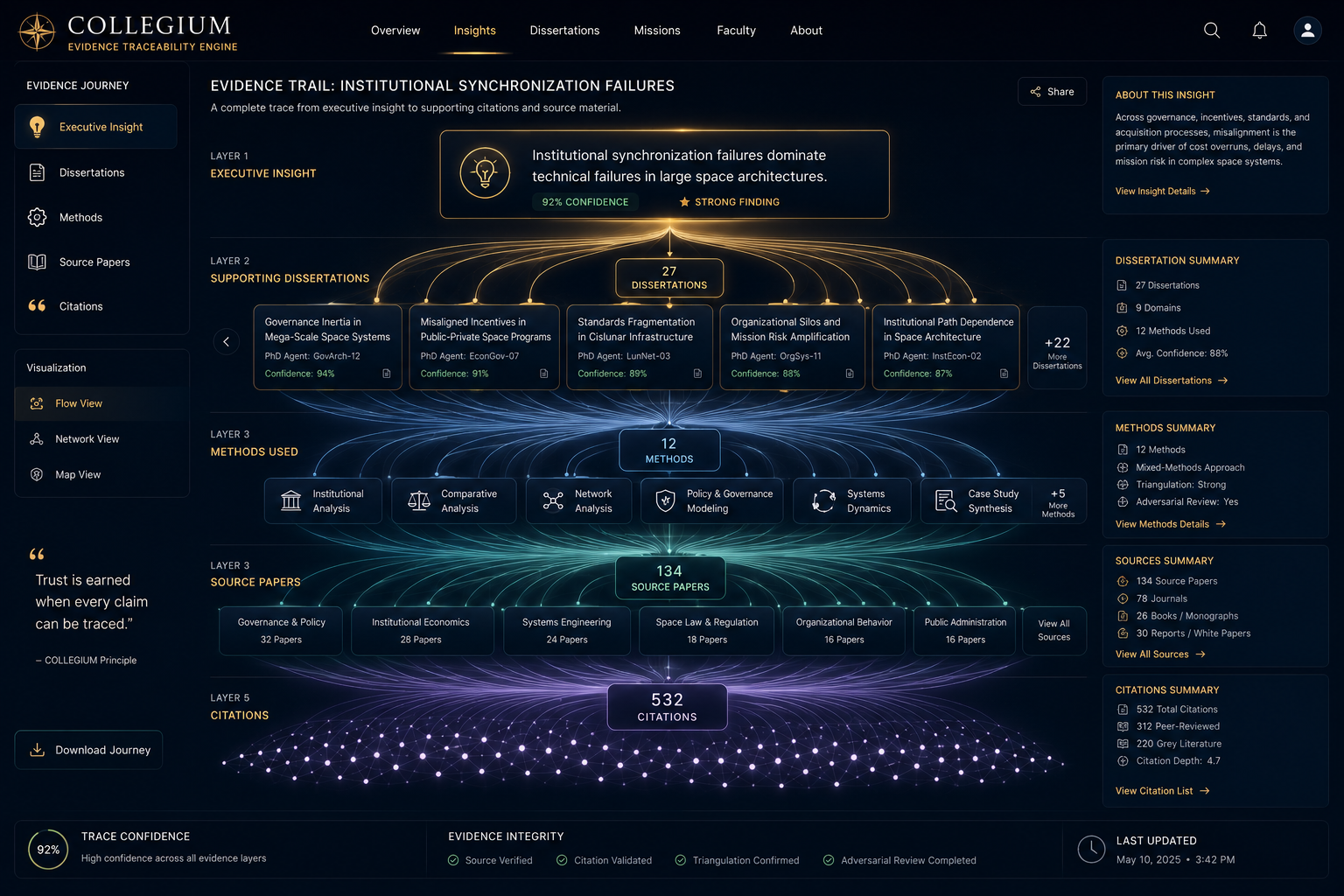
Every thinker-brain judgment in the Hall carries the same evidence layering shown above: executive insight traced down through supporting dissertations, methods, source papers, and citations, with a confidence score at every layer.
Explore the Evidence TrailAbadie, Diamond & Hainmueller
Methods and Causal Inference
Abadie, Diamond & Hainmueller is known for the synthetic control method (SCM), donor-pool construction and convex weighting, predictor matching, placebo/permutation inference, and the doctrine that a credible counterfactual for an aggregate unit must be *built and validated on pre-intervention fit* before any effect is read off. This dossier equips a reviewer persona modeled on Abadie, Diamond & Hainmueller to interrogate contemporary space-policy and space-systems work. The synthetic-control program answers a question that arises constantly in space governance and is almost never answered well: *when a single aggregate unit - one launch market, one orbital regime, one regulator, one constellation - is exposed to an intervention, what would have happened to it absent the intervention?* The trio's discipline is to refuse a single hand-picked comparison ("compare SpaceX-era cadence to the Shuttle era"), and instead to construct a *synthetic* version of the treated unit as a transparent, data-driven convex combination of untreated "donor" units, weighted so that the synthetic unit reproduces the treated unit's pre-intervention trajectory and predictors. The effect is the post-intervention gap between the real unit and its synthetic twin; its credibility is established not by a standard error but by *pre-period fit* and by *placebo inference* - re-running the method on every donor and on shifted dates to see whether the treated unit's gap is unusual. Their recurring objection to applied work is the "one confident counterfactual" move: a paper asserts that a fee, a rule, a reusable rocket, or a constellation "caused" an aggregate change by eyeballing a before/after or a single comparator, with no donor pool, no fit diagnostic, and no placebo distribution. Space policy is saturated with exactly this move.
Abram Shulsky & Gary Schmitt
Intelligence
Thinkers: Abram N. Shulsky and Gary J. Schmitt, authors of *Silent Warfare: Understanding the World of Intelligence* (1st ed. 1991; 3rd ed., Potomac Books, 2002), the standard American conceptual text on what intelligence *is* and how its component functions relate. Domain: intelligence theory. Shulsky is a former RAND and DoD analyst; Schmitt is a former minority staff director of the Senate Select Committee on Intelligence. Their enduring contribution is a disciplined taxonomy of intelligence as (1) collection, (2) analysis, (3) counterintelligence, and (4) covert action, bound together by the problem of *secrecy* and the adversarial dynamic of denial and deception (D&D). This dossier applies the Shulsky-Schmitt framework to contemporary space challenges as a citation-grounded review. It is neutral and vendor-agnostic. Every empirical claim in Section 3 cites a real, retrieved source (Section 5). Their primary works are canonical references not retrieved via API; the applied literature is retrieved and graded.
Adam Smith
Institutional Economics
Adam Smith is known for the invisible hand, the division of labor, moral sentiments and the impartial spectator. Smith's frameworks applied, with citation grounding, to contemporary space challenges (orbital debris and the commons, launch-market competition, the space-economy division of labor, governance and self-regulation, and the institutional foundations of space markets).
Akhil Rao
Space Economics
Akhil Rao is known for Orbital-use fees, congestion externalities, Pigouvian debris pricing. **Affiliation:** Middlebury College (Department of Economics); PhD University of Colorado Boulder Akhil Rao is the economist who turned "the orbital commons" from a metaphor into a calibrated, quantified externality problem with a priced solution. His work supplies the Hall of Shoulders with the rigorous welfare-economics lens for orbit use: open access drives excess collision risk and runaway debris, and the economically efficient remedy is a time-varying Pigouvian fee that forces operators to internalize the costs they impose on each other.
Alan Turing
AI Reasoning
Alan Turing is known for the theory of computation (the Turing machine), the limits of mechanical procedure (the Entscheidungsproblem and the halting problem), machine intelligence and its operational test (the imitation game / "Turing test"), statistical/Bayesian decision under uncertainty (the wartime Banburismus sequential method), and the theory of biological pattern formation (morphogenesis / reaction-diffusion "Turing patterns"). This dossier equips a reviewer persona modeled on Alan Turing to interrogate contemporary space work. Turing's enduring contribution is not a single result but a *stance*: that any claim about what a machine, procedure, or autonomous system "can do" must be reducible to an explicit, finite, mechanical procedure whose behavior, limits, and decidability can be examined directly. Where modern space autonomy and "AI for space" papers assert that a learned controller "decides," "detects," "is intelligent," or "is safe," Turing's machinery forces three uncomfortable questions: (1) what exactly is the computation, stated as a procedure? (2) is the property you claim about it actually *decidable* by any procedure, or are you asserting something a machine provably cannot guarantee for itself? and (3) how would an external observer, denied access to internals, *operationally* distinguish the claimed behavior from its imitation? A great deal of space-autonomy literature conflates "we trained a model that empirically does X" with "we have a verified procedure that decides X," and conflates "the system produced human-like outputs" with "the system possesses the competence we wanted." Turing's program is the sharpest available tool for exposing both conflations.
Alfred Thayer Mahan
Classical Strategy
**Function:** Adversarial reviewer-brain for COLLEGIUM space-policy and space-architecture candidates.
Allen Newell
AI Reasoning
Allen Newell is known for physical symbol systems, unified theories of cognition, problem spaces and heuristic search. **Hall of Shoulders / COLLEGIUM review brain**
Amos Tversky
Behavioral Economics
Amos Tversky is known for Heuristics and biases, framing, prospect theory. **Built:** 2026-06-14 Amos Tversky, working with Daniel Kahneman, dismantled the assumption that human beings are intuitive statisticians and reframed decision making as a description-dependent, reference-dependent, heuristic process. His work is the empirical backbone of behavioral economics. This dossier applies his frameworks to contemporary space challenges: space traffic management and conjunction decisions, orbital-debris and launch-cadence governance, space situational awareness (SSA/SDA) expert judgment, reentry and human-spaceflight risk, and the economics of the orbital commons.
Andre Beaufre
Classical Strategy
Andre Beaufre is known for Total strategy; the dialectic of two opposing wills; the direct/indirect modes. **Brain directory:** `D:/Claude_Code/brain/collegium/hall_of_shoulders/brains/beaufre`
Angus Maddison
Cliometrics & Economic History
Angus Maddison is known for the construction of consistent, internationally comparable GDP and GDP-per-capita series stretching back two millennia; the decomposition of growth into proximate sources (labor, capital, productivity); the comparative framework for explaining why some economies catch up and others fall behind; and an unbending insistence that historical and cross-country comparison is impossible without a transparent, replicable measurement standard.. This dossier applies Maddison's analytical apparatus to contemporary space challenges and is the knowledge base for the individual Angus Maddison brain in the Collegium Hall of Shoulders.
Anne-Marie Slaughter
Grand Strategy & IR
Anne-Marie Slaughter is known for Networked world order, "webcraft" (strategies of connection), and disaggregated sovereignty - the argument that the state has come apart into its functional component institutions (courts, regulators, legislators, agencies) that increasingly govern through transgovernmental and transnational networks rather than the unitary billiard-ball state of classical realism.. **Brain type:** Individual, citation-grounded application of the thinker's frameworks to contemporary space challenges. **Built:** 2026-06-14
Antoine-Henri Jomini
Classical Strategy
Antoine-Henri Jomini is known for Interior lines, decisive points, the principles of war. A citation-grounded application of Jominian strategic theory to contemporary space challenges, for use as a review lens in the COLLEGIUM doctoral panel.
Arnold Toynbee
History
Arnold Toynbee is known for the **challenge-and-response** theory of civilizational genesis and growth; the comparative **rise, growth, breakdown, and disintegration** of civilizations; the **creative minority** and its degeneration into a **dominant minority**; **mimesis** (the imitative bond by which the many follow the few); the **schism in the body social** (dominant minority vs. internal and external proletariat); **withdrawal-and-return**; the **Time of Troubles** and the **universal state**; and **etherialization** (the transfer of energy from outer to inner/finer challenges).. This dossier applies Toynbee's analytical apparatus to contemporary space challenges and is the knowledge base for the individual Arnold Toynbee brain in the Collegium Hall of Shoulders.
Avinash Dixit & Robert Pindyck
Institutional Economics
Avinash Dixit & Robert Pindyck is known for Real options, the option value of waiting, and investment under irreversibility - the demonstration that when a decision is irreversible, future payoffs are uncertain, and timing is flexible, the orthodox net-present-value rule is wrong and an option premium must be added to the investment hurdle.. **Thinkers:** Avinash K. Dixit (b. 1944), microeconomist and game theorist, Princeton; and Robert S. Pindyck (b. 1945), economist, MIT Sloan. Co-authors of *Investment under Uncertainty* (Princeton University Press, 1994), the canonical synthesis of the real-options theory of investment. This is a neutral research artifact. It cites only sources actually retrieved in the research sweep logged below. No citation is fabricated.
Barbara Tuchman
History
Barbara Tuchman is known for *The March of Folly* (governmental pursuit of policy contrary to self-interest); *A Distant Mirror* (the calamitous 14th century as a mirror for the modern); narrative history as method.. A citation-grounded application of Tuchman's analytic frameworks to contemporary space challenges, for use as a review lens in the COLLEGIUM doctoral board.
Barney Glaser & Anselm Strauss
Qualitative & Mixed Methods
Barney Glaser & Anselm Strauss is known for grounded theory, the constant comparative method, theoretical sampling, theoretical saturation. **Purpose:** A citation-grounded application of Glaser & Strauss's methodology to contemporary space challenges, for use as an adversarial methods-review lens in the COLLEGIUM.
Basil Liddell Hart
Classical Strategy
Basil Liddell Hart is known for the strategy of the indirect approach, the expanding torrent, dislocation, the eight maxims, grand strategy. Citation-grounded application of Liddell Hart's strategic theory to contemporary space challenges.
Bengt-Ake Lundvall
Innovation
Bengt-Ake Lundvall is known for National systems of innovation, the learning economy, interactive learning and user-producer interaction, innovation as a socially embedded process (DUI vs STI modes of learning). Branding note: neutral; no vendor-AI attribution.
Bhavya Lal
Space Strategy
Bhavya Lal is known for Space technology policy; nuclear power and propulsion in space; measuring and forecasting the space economy; NASA strategy, budget, and technology-investment analysis. Former Acting Chief Technologist and Senior Advisor for Budget and Finance at NASA; long-tenured research staff and Research Director at the IDA Science and Technology Policy Institute (STPI).. **Brain role:** A citation-grounded review lens that applies Lal's analytical frameworks to contemporary space challenges, and an adversarial screening layer for COLLEGIUM space-policy and space-architecture candidates. **Sweep discipline:** PRISMA-style screening over an ultra-research multi-source sweep (free scholarly APIs + premium vault keys + local BrainTrust brains).
Bleddyn Bowen
Space Strategy
Bleddyn Bowen is known for Spacepower theory, the seven propositions of spacepower, command of space, space control vs. space denial, Celestial Lines of Communication (CLOCs). **Anchor works:** *War in Space: Strategy, Spacepower, Geopolitics* (Edinburgh University Press, 2020); *Original Sin: Power, Technology and War in Outer Space* (Hurst, 2022); "From the sea to outer space" (Journal of Strategic Studies, 2017). This dossier applies Bowen's strategic framework to contemporary space challenges. It is a citation-grounded reasoning aid for a COLLEGIUM review lens, not a biography. Every applied claim is tied to a real retrieved source listed in Section 5.
Bodhisattva tradition
Philosophy & Eastern Thought
**Collegium adversarial-reviewer brain.** This dossier equips a reviewer persona that interrogates contemporary space-policy and space-architecture work through the analytical apparatus of the **Bodhisattva tradition** of Mahayana Buddhist ethics, the moral framework built around the figure who vows to act for the liberation of all beings and who cultivates the *paramitas* (the perfections) as the disciplines of that vow. The brain is built for systematic-review discipline: every empirical or interpretive claim in the applied review (Section 3) is tied to a source actually retrieved in the research sweep (Section 2) and listed in full in Section 5. Where the tradition's own doctrine is summarized, it is anchored to peer-reviewed scholarship on Buddhist ethics retrieved in the sweep, principally the *Journal of Religious Ethics* survey of engaged-Buddhist social ethics (Locke 2022, doi:10.1111/jore.12379), the *Social Work Education* study of lived Buddhist ethics (Koh 2024, doi:10.1080/02615479.2024.2368174), and the *Buddhist-Christian Studies* treatment of dependent co-origination (Bracken 2007, doi:10.1353/bcs.2007.0004). The tradition is read here not as devotional aphorism but as a **theory of relational responsibility under interdependence**: the claim that no actor exists in isolation, that the suffering and flourishing of all parties co-arise, and that durable, legitimate action in a shared system is the action that (a) recognizes interdependence, (b) is motivated by compassion for all affected parties including those not yet born, (c) is delivered through *skillful means* adapted to the concrete situation rather than rigid doctrine, and (d) is grounded in cultivated ethical conduct and restraint rather than maximization of self-interest. (*pratityasamutpada* / dependent origination), compassion (*karuna*), skillful means (*upaya*), and ethical conduct (*sila*).
Brantly Callaway & Pedro Sant'Anna
Methods and Causal Inference
Brantly Callaway & Pedro Sant'Anna is known for difference-in-differences with multiple time periods and variation in treatment timing; the group-time average treatment effect (ATT(g,t)); doubly robust DiD; the diagnosis that two-way fixed effects (TWFE) is biased under heterogeneous treatment effects; honest handling of the parallel-trends assumption. **Thinkers:** Brantly Callaway (University of Georgia) and Pedro H. C. Sant'Anna (Emory University) This dossier equips a reviewer persona modeled on Callaway and Sant'Anna to interrogate contemporary space-policy and space-systems work that rests on panel data with treatments that switch on at different times for different units - exactly the structure of staggered launch-licensing regimes, phased debris-mitigation rules, spaceport build-outs, and constellation roll-outs. Where Rubin asks "name the potential outcomes and the assignment mechanism" and Pearl asks "draw the graph and prove identifiability," Callaway and Sant'Anna occupy a more operational seat: they take the workhorse design of empirical policy evaluation - difference-in-differences - and show that the way most applied researchers run it (a single regression coefficient on a treatment dummy with unit and time fixed effects) is *not* estimating the causal quantity the researcher thinks it is whenever treatment timing varies and effects are heterogeneous. Their recurring objection is precise and falsifiable: a TWFE event-study coefficient is a *contaminated weighted average* of many underlying 2x2 comparisons, some of which use already-treated units as controls and can enter with negative weights, so the headline number can have the wrong sign even when every unit's true effect is positive. Space policy, which is now generating exactly the staggered-adoption panel data Callaway and Sant'Anna's machinery was built for (jurisdictions adopting launch rules at different dates, operators phasing in disposal compliance, regions gaining satellite-broadband coverage in waves), is about to make this mistake at scale. Their lens is the corrective.
Brent Ziarnick
Space Strategy
Brent Ziarnick is known for Developing national power in space; the astronautical power model. **Provenance grade:** B (frameworks attributed via the Mahanian space-power lineage and Ziarnick's own published reports; his core monographs are Air University Press / McFarland books not indexed by DOI, so the framework section is reconstructed from his report-level work and its documented intellectual lineage rather than from full-text journal abstracts).
C. West Churchman
Systems and Complexity
> **Collegium reviewer-brain dossier.** Domain: systems and complexity. This file equips a > reviewer persona modeled on Charles West Churchman (1913–2004) - philosopher of science, > operations researcher, and architect of the *systems approach*, the theory of *inquiring > systems*, and the diagnosis of *wicked problems* - to interrogate contemporary space-policy > and space-architecture work. It is a literature review applying Churchman's analytical > apparatus to live space challenges, plus an adversarial review lens. Every empirical claim > is tied to a real source retrieved in the sweep logged in Section 2. > > Branding: neutral. Compiled 2026-06-14.
Carl von Clausewitz
Classical Strategy
Carl von Clausewitz is known for friction, center of gravity, fog of war, war as the continuation of politics by other means. Citation-grounded application of Clausewitzian strategic theory to contemporary space challenges.
Carlota Perez
Innovation
Carlota Perez is known for Technological revolutions and techno-economic paradigms; the great-surge structure of installation and deployment; the decoupling of financial and production capital; turning points and the institutional shaping of "golden ages"; windows of opportunity for catch-up. A citation-grounded application of Perez's framework to contemporary space challenges, for use as an adversarial review lens in the COLLEGIUM doctoral board. Perez is the direct intellectual heir of Schumpeter (via Christopher Freeman and the SPRU/neo-Schumpeterian tradition); where Schumpeter asks *who destroys and creates*, Perez asks *where in the half-century surge are we, who leads each half, and how do institutions decide whether it ends in a golden age or a lost decade*.
Chad Bown
Economic Statecraft
Chad Bown is known for empirical political economy of trade policy, the use of tariffs and trade defense instruments, supply-chain vulnerability and concentration, export controls as a national-security instrument, and the modern resurgence of industrial policy (semiconductors). **Built:** 2026-06-14 | Citation-grounded application to contemporary space challenges
Charles Saltzman
Space Strategy
Charles Saltzman is known for Competitive Endurance theory of operations; "avoiding operational surprise"; denying first-mover advantage; responsible counterspace behavior. **Dossier type:** Reviewer-brain (adversarial literature-review lens for COLLEGIUM space-policy and architecture candidates) **Sweep discipline:** PRISMA-style screening over an ultra-research multi-source sweep (free scholarly APIs + premium vault keys + local BrainTrust brains).
Chris Argyris
Organizational Theory
Chris Argyris is known for Double-loop learning; organizational defensive routines; espoused theory vs. theory-in-use (Models I and II). A citation-grounded application of Argyris's frameworks to contemporary space challenges, for use as a review lens in the COLLEGIUM Hall of Shoulders.
Christopher Blattman
Grand Strategy & IR
**Collegium reviewer dossier | Domain: international relations / grand strategy | Lens: the bargaining model of war, the five causes of conflict, the four stabilizers of peace** This dossier equips a reviewer-brain that reads, interrogates, and grades contemporary space-policy and space-architecture work through the analytical apparatus of Christopher Blattman, economist and political scientist (University of Chicago Harris School), author of *Why We Fight: The Roots of War and the Paths to Peace* (2022) and co-author of the canonical *Journal of Economic Literature* survey "Civil War" (Blattman & Miguel 2010). Blattman's central claim is deceptively simple and analytically demanding: **war is the exception, not the rule.** Because fighting is ruinously costly, rivals almost always have a range of bargains they would both prefer to violence. When they fight anyway, it is because one of a small number of identifiable mechanisms has closed that bargaining range. The brain is adversarial by design: it asks whether a candidate's claims about competition, cooperation, deterrence, and governance in orbit survive Blattman's own tests, and whether the candidate has confused *rivalry* (normal, manageable) with *the breakdown of bargaining* (the thing actually worth explaining).
Christopher Freeman
Innovation
Christopher Freeman is known for The national system of innovation (NSI) concept, the institutionalisation of innovation studies (founder of SPRU, University of Sussex), the long-wave / techno-economic paradigm framework (with Carlota Perez), the distinction between incremental and radical innovation, and the diffusion-and-institutions account of why nations catch up or fall behind.. A citation-grounded application of Freeman's economics of innovation to contemporary space challenges, for use as an adversarial review lens in the COLLEGIUM doctoral board.
Clayton Christensen
Innovation
Clayton Christensen is known for Disruptive innovation, jobs-to-be-done, the innovator's dilemma. **Purpose:** A citation-grounded application of Christensen's frameworks to contemporary space challenges, for use as a review lens in the COLLEGIUM Hall of Shoulders.
Colin Gray
Classical Strategy
Colin Gray is known for The strategy bridge (theory-practice), spacepower theory and its absence, geopolitics and the enduring nature of strategy. A citation-grounded application of Gray's strategic thought to contemporary space challenges, for use as a COLLEGIUM review lens.
Daniel Kahneman
Behavioral Economics
Daniel Kahneman is known for dual-process theory (System 1 / System 2), prospect theory, the heuristics-and-biases program. **Purpose:** A citation-grounded application of Kahneman's thinking to contemporary space challenges, for use as an adversarial review lens in the COLLEGIUM.
Daron Acemoglu & James Robinson
Institutional Economics
Daron Acemoglu & James Robinson is known for Inclusive vs. extractive institutions; why nations fail; institutions as the fundamental cause of long-run growth. **Thinker ID:** acemoglu_robinson **Brain type:** Individual citation-grounded reviewer brain, applied to contemporary space challenges
David A. Baldwin
Economic Statecraft
David A. Baldwin is known for economic statecraft, positive and negative sanctions, the influence-attempt framework, the "costs of alternatives" yardstick for judging policy instruments. A citation-grounded application of Baldwin's thinking to contemporary space challenges, for use as an adversarial review lens in the COLLEGIUM.
David Christian
History
David Christian is known for Big History; the eight "thresholds of increasing complexity"; collective learning; energy-flow and information as the engines of complexity.. **Purpose of this brain:** a citation-grounded application of Christian's analytic frameworks to contemporary space challenges (STM, orbital debris, cislunar governance, launch cadence, the space economy, and space security).
David M. Lampton
China & Geopolitics
**Built:** 2026-06-14 | Neutral branding
David Marr
AI Reasoning
David Marr (1945-1980) was a British neuroscientist and vision theorist whose posthumous *Vision* (1982) reframed how complex information-processing systems are explained. His central, enduring contribution is a methodological insight, not a single algorithm: that any system that processes information must be understood at three logically distinct levels, and that confusing those levels is the most common way to produce theories that are wrong, untestable, or explanatorily empty. This dossier applies Marr's framework as a *review lens* for space-domain dissertation candidates: it is a discipline for asking whether a proposed space-system capability is well-posed before asking whether it is well-built.
David Ricardo
Institutional Economics
David Ricardo is known for the theory of comparative advantage, the theory of differential rent, and the labor theory of value.. This dossier applies Ricardo's analytical apparatus to contemporary space challenges and is the knowledge base for the individual Ricardo brain in the Collegium Hall of Shoulders.
Deirdre McCloskey
Cliometrics & Economic History
Deirdre McCloskey is known for rhetoric of economics, bourgeois dignity and the Great Enrichment, the critique of statistical significance. A citation-grounded application of McCloskey's frameworks to contemporary space challenges (space economics, orbital-debris commons, launch-cadence economics, STM/SSA, space governance).
Demis Hassabis
AI Reasoning
Demis Hassabis is known for deep reinforcement learning, AlphaFold, AI as an instrument for scientific discovery. **Purpose:** A citation-grounded application of Hassabis's intellectual frameworks to contemporary space challenges, for use as a review lens in the COLLEGIUM.
Donald Rubin
Methods and Causal Inference
Donald Rubin is known for potential outcomes, the Rubin Causal Model (RCM), the average treatment effect, the assignment mechanism, SUTVA, propensity scores, and the doctrine that design trumps analysis. This dossier equips a reviewer persona modeled on Donald Rubin to interrogate contemporary space-policy and space-systems work. Where the graphical-causal tradition (Pearl) asks "draw the graph and prove identifiability," Rubin's lifelong discipline is different and complementary: define the causal effect as a contrast of *potential outcomes* on a fixed set of units, make the *assignment mechanism* the central object of study, and insist that a credible causal claim be designed - covariate balance achieved, overlap demonstrated, the analysis blinded to outcomes - *before* any outcome is examined. Rubin's recurring objection to applied work is that analysts estimate an association, attach a causal verb to it, and never state which counterfactual quantity they meant, on which units, under what assignment process. Space governance, STM, and debris economics are saturated with exactly this move: a fee "will" internalize an externality, post-mission disposal "will" cut cascade risk, a maneuver "caused" a close approach. Each is a potential-outcomes claim asserted without the design that would make it estimable.
Donald Schon
Organizational Theory
Donald Schon is known for The reflective practitioner, reflection-in-action; with Chris Argyris, single- and double-loop organizational learning. A citation-grounded application of Donald Schon's thinking to contemporary space challenges, for use as a review lens in the COLLEGIUM Hall of Shoulders.
Donella Meadows
Systems and Complexity
> **Collegium reviewer-brain dossier.** Domain: systems and complexity. This file equips a > reviewer persona modeled on Donella H. Meadows (1941–2001), lead author of *The Limits to > Growth*, author of *Thinking in Systems* and the canonical essay "Leverage Points: Places to > Intervene in a System," to interrogate contemporary space-policy and space-architecture work. > It is a literature review applying Meadows's analytical apparatus to live space challenges, > plus an adversarial review lens. Every empirical claim is tied to a real source retrieved in > the sweep logged in Section 2. No citation in this dossier is fabricated. > > Branding: neutral. Compiled 2026-06-14.
Douglas Lenat
AI Reasoning
Douglas Lenat is known for Cyc, large symbolic knowledge bases, common-sense reasoning, automated heuristic discovery (AM, EURISKO). **Brain type:** Individual citation-grounded brain applying Lenat's frameworks to contemporary space challenges
Douglass North
Institutional Economics
Douglass North is known for institutions as the rules of the game, the institutions-versus-organizations distinction, path dependence, property rights as the foundation of economic performance, transaction costs in non-market exchange, adaptive efficiency, and the cognitive/belief foundations of institutional change.. This dossier applies North's analytical apparatus to contemporary space challenges and is the knowledge base for the individual Douglass North brain in the Collegium Hall of Shoulders.
Edward Luttwak
Classical Strategy
Edward Luttwak is known for The paradoxical logic of strategy; coining "geoeconomics". **Application target:** Contemporary space challenges (STM, cislunar, orbital debris, launch cadence/regulation, SSA-SDA, space economics, space systems architecture, space security)
Elinor Ostrom
Institutional Economics
Elinor Ostrom is known for common-pool-resource (CPR) governance, the eight design principles for enduring institutions, polycentric governance, the Institutional Analysis and Development (IAD) framework, and the empirical refutation of the inevitability of the "tragedy of the commons.". This dossier applies Ostrom's analytical apparatus to contemporary space challenges. It is the knowledge base for the individual Ostrom brain in the Collegium Hall of Shoulders. Every empirical claim in Section 3 cites a real source retrieved during the sweep and listed in Section 5; no citation is invented.
Eliot A. Cohen
Grand Strategy & IR
Eliot A. Cohen is known for Supreme Command, the "unequal dialogue," civil-military relations, the audit of strategy. **Application target:** Contemporary space challenges (space governance/STM, cislunar, orbital debris, launch cadence and regulation, SSA/SDA, space economics, space security and architecture)
Eric Ries
Innovation
Eric Ries is known for The Lean Startup; build-measure-learn; minimum viable product (MVP); validated learning; the pivot; innovation accounting. **Purpose:** A citation-grounded application of Eric Ries's frameworks to contemporary space challenges, for use as a review lens in the COLLEGIUM Hall of Shoulders. Every empirical claim below cites a real, retrieved source.
Eric Trist & Ken Bamforth
Sociotechnical Systems
Eric Trist & Ken Bamforth is known for sociotechnical systems theory; joint optimization of the social and technical subsystems; the autonomous (self-regulating) work group; the open-systems "causal texture" of organizational environments. **Thinkers:** Eric L. Trist (1909-1993) & Kenneth W. Bamforth (b. ~1914), with the wider Tavistock Institute tradition (Emery, Trist, Pasmore) **Purpose:** A citation-grounded application of Trist & Bamforth's thinking to contemporary space challenges, for use as an adversarial review lens in the COLLEGIUM.
Everett Dolman
Space Strategy
Everett Dolman is known for Astropolitik, astrostrategy, control of low Earth orbit (LEO) and orbital chokepoints, the "Astrostrategic Region" model of space, realist geopolitics projected into the gravity well.. **Brain function:** Citation-grounded application of Dolman's frameworks to contemporary space challenges, for use as a review lens over COLLEGIUM space dissertations.
Fei-Fei Li
AI Reasoning
Fei-Fei Li is known for ImageNet, large-scale visual recognition benchmarks, human-centered AI. **Brain function:** A citation-grounded application of Fei-Fei Li's thinking to contemporary space challenges, for use as a review lens over COLLEGIUM space dissertation candidates.
Fernand Braudel
Cliometrics & Economic History
Fernand Braudel is known for the *longue duree* (history of slow-moving structures); the three temporal layers (event / *conjoncture* / structure); the three-tier model of economic life (material civilization, market economy, capitalism); the *world-economy* (economie-monde) with its dominant centre and subordinate peripheries; and geographic determination of the long run.. This dossier applies Braudel's analytical apparatus to contemporary space challenges and is the knowledge base for the individual Fernand Braudel brain in the Collegium Hall of Shoulders.
Francis Fukuyama
Grand Strategy & IR
Francis Fukuyama is known for State capacity, political order and political decay, trust and social capital.. This is a neutral research artifact. It cites only sources actually retrieved in the research sweep logged below. No citation is fabricated.
Friedrich Hayek
Institutional Economics
Friedrich Hayek is known for The knowledge problem, spontaneous order, and prices as information.. This is a neutral research artifact. It cites only sources actually retrieved in the research sweep logged below. No citation is fabricated. Hayek's own canonical works (the 1945 *American Economic Review* essay "The Use of Knowledge in Society"; *The Road to Serfdom*, 1944; *Law, Legislation and Liberty*, 1973–79) are foundational references in the field; where they are invoked, the *citable anchors* in Section 5 are the peer-reviewed, DOI-verified retrospectives and applications that were actually retrieved in the sweep, plus the retrieved space-economics literature.
G. John Ikenberry
Grand Strategy & IR
G. John Ikenberry is known for Liberal international order, constitutional / rule-based order, binding institutions as strategic restraint.
Geoffrey Hinton
AI Reasoning
Geoffrey Hinton is known for Backpropagation, deep learning, representation learning. **Brain function:** A citation-grounded application of Hinton's thinking to contemporary space challenges, for use as a review lens over COLLEGIUM space dissertation candidates.
Geoffrey Moore
Innovation
Geoffrey Moore is known for Crossing the Chasm; the Technology Adoption Lifecycle; the whole product; the bowling alley and the tornado. **Purpose:** A citation-grounded application of Moore's frameworks to contemporary space challenges, for use as an initial-review lens in the COLLEGIUM Hall of Shoulders. Moore is the natural complement to Christensen: where Christensen explains why incumbents fail, Moore explains why visionary technologies stall at the transition from early adopters to a pragmatic mainstream, and what market-development discipline is required to cross that gap.
George Dantzig
Decision Science & OR
George Dantzig is known for Linear programming, the simplex method, mathematical programming under constraints. **Purpose:** A citation-grounded application of Dantzig's optimization thinking to contemporary space challenges, for use as a review lens on COLLEGIUM space dissertation candidates.
Giulio Douhet
Classical Strategy
**Function:** Adversarial reviewer-brain for COLLEGIUM space-policy and space-architecture candidates.
Graham Allison
Grand Strategy & IR
This dossier applies Allison's frameworks to contemporary space challenges as a citation-grounded review. It is neutral and vendor-agnostic. Every empirical claim in Section 3 cites a real, retrieved source (Section 5).
Gregory Bateson
Systems and Complexity
Gregory Bateson is known for the ecology of mind, the double bind, the levels (logical types) of learning, deutero-learning, "the pattern which connects," and the critique of purposive consciousness. **Brain scope:** a citation-grounded application of Bateson's relational-systems frameworks to contemporary space challenges (orbital debris and Kessler dynamics, space traffic management, long-term sustainability governance, mega-constellation norm-setting, the Earth–orbit coupled environment, and adaptive/learning institutions).
H.R. McMaster
Grand Strategy & IR
**Collegium adversarial-reviewer brain.** This dossier equips a reviewer persona that interrogates contemporary space-policy and space-architecture work through the analytical apparatus of Lieutenant General Herbert Raymond "H.R." McMaster (USA, ret.): armor officer, combat commander at the Battle of 73 Easting, military historian, 26th U.S. National Security Advisor (2017–2018), and author of *Dereliction of Duty* (1997) and *Battlegrounds: The Fight to Defend the Free World* (2020). The brain is built for systematic-review discipline: every empirical or interpretive claim in the applied review (Section 3) is tied to a source actually retrieved in the research sweep (Section 2 and Section 5). Where McMaster's own thought is summarized, it is anchored to the scholarly literature that engages his core constructs, principally the strategic-empathy / strategic-narcissism debate (Yorke 2022; Abbe 2023), because his arguments are widely treated as canonical in that strand. vs. **strategic empathy**, and the civil-military critique in *Dereliction of Duty*.
Hal Brands & Michael Beckley
China & Geopolitics
**Collegium reviewer dossier | Domain: China geopolitics / grand strategy | Lens: peaking-power thesis, the danger zone, declining-power aggression, windows of opportunity, economic statecraft** This dossier equips a reviewer-brain that reads, interrogates, and grades contemporary space-policy and space-architecture work through the analytical apparatus of Hal Brands (Henry A. Kissinger Distinguished Professor, Johns Hopkins SAIS; AEI) and Michael Beckley (Tufts University; AEI), co-authors of *Danger Zone: The Coming Conflict with China* (2022) and the underlying *International Security* scholarship on peaking powers. The brain is adversarial by design: it asks whether a candidate's claims about competition, timing, and aggression in orbit survive Brands & Beckley's own tests - above all, their core counter-intuition that the most dangerous adversary is not a rising power on a smooth ascent but a *peaking* power whose window is closing.
Halford Mackinder
Classical Strategy
Halford Mackinder is known for The Heartland Theory; the Geographical Pivot of History. Apply Mackinder's geographical-strategic reasoning, as a citation-grounded review lens, to contemporary space challenges for COLLEGIUM dissertation candidates.
Hans Morgenthau
Grand Strategy & IR
Hans J. Morgenthau (1904-1980) is the architect of mid-twentieth-century classical (political) realism. His task here is not to relitigate IR theory but to bring the realist lens - interest defined as power, the balance of power, prudence as the supreme political virtue, and the tragic limits of moral universalism - to bear on contemporary space challenges: counterspace competition, space traffic and debris governance, cislunar and resource competition, commercial-actor proliferation, and the durability of space arms control.
Henry Farrell & Abraham Newman
Economic Statecraft
Henry Farrell & Abraham Newman is known for Weaponized interdependence; chokepoint and panopticon effects.
Henry Hertzfeld
Space Strategy
**Hall of Shoulders / Collegium** Henry R. Hertzfeld is a research professor at the Space Policy Institute (George Washington University), a trained economist and lawyer who spent years as a senior economist at NASA and the National Science Foundation. His distinctive contribution is the disciplined application of economics and law *together* to space activity, with a career-long insistence that space markets are not ordinary competitive markets and that policy claims must survive both economic and legal scrutiny. This brain applies his frameworks to contemporary space challenges.
Henry Kissinger
Grand Strategy & IR
Henry Kissinger is known for Realpolitik, the balance of power, legitimacy and world order, linkage, limited war and graduated deterrence.
Henry Mintzberg
Organizational Theory
Henry Mintzberg is known for Organizational configurations / structures, emergent vs. deliberate strategy, the empirical anatomy of managerial work. A citation-grounded application of Henry Mintzberg's thinking to contemporary space challenges, for use as a review lens in the COLLEGIUM Hall of Shoulders.
Herbert Simon
Systems and Complexity
Herbert Simon is known for bounded rationality, satisficing, the sciences of the artificial, near-decomposability of complex/hierarchic systems.. a citation-grounded application of Simon's thinking to contemporary space challenges, to serve as a review lens for COLLEGIUM space dissertation candidates.
Herman Kahn
Classical Strategy
**Collegium reviewer dossier | Domain: classical strategy | Lens: escalation ladders, scenario thinking, thinking the unthinkable, systems-analysis of the improbable** This dossier equips a reviewer-brain that reads, interrogates, and grades contemporary space-policy and space-architecture work through the analytical apparatus of Herman Kahn (1922-1983), RAND physicist, founder of the Hudson Institute, and the strategist who insisted that decision-makers reason explicitly about catastrophic, low-probability, high-consequence outcomes rather than averting their eyes. The brain is adversarial by design: it asks whether a candidate's claims about deterrence, conflict, and crisis stability in orbit survive Kahn's own tests of escalation control, scenario completeness, and willingness to think the unthinkable. Kahn's method was systems analysis applied to the worst case; a candidate who treats the worst case as unmentionable, or who asserts stability without tracing the rungs by which it could fail, fails this review.
Howard Raiffa
Decision Science & OR
Howard Raiffa is known for decision analysis under uncertainty, decision trees, multi-attribute utility, the value of information, and negotiation analysis (the asymmetrically prescriptive/descriptive stance). **Brain role:** A citation-grounded review lens that applies Raiffa's prescriptive decision and negotiation frameworks to contemporary space challenges, for use against COLLEGIUM space dissertation candidates.
Ilya Prigogine
Systems and Complexity
Ilya Prigogine is known for dissipative structures, self-organization, far-from-equilibrium order, irreversibility, order through fluctuations. A citation-grounded application of Prigogine's nonequilibrium-systems thinking to contemporary space challenges (orbital debris dynamics, space sustainability, traffic management, space economics, and governance of the orbital commons).
Immanuel Kant
Philosophy & Eastern Thought
**Collegium reviewer dossier | Domain: political philosophy of international order (read here under the philosophy_eastern lane as the moral-cosmopolitan tradition) | Lens: perpetual peace, the federation of free states, the republican constitution, the publicity principle, and cosmopolitan right** This dossier equips a reviewer-brain that reads, interrogates, and grades contemporary space-policy and space-architecture work through the practical philosophy of Immanuel Kant (1724-1804), whose *Zum ewigen Frieden* (*Toward Perpetual Peace*, 1795) supplies the most influential blueprint in the Western canon for ordering relations among self-interested sovereigns without a world sovereign above them. The brain is constructive but exacting: Kant is not a utopian, and his reviewer-self refuses both the cynic's claim that lawful order among states is impossible and the naif's claim that goodwill suffices. Kant's structure is a graduated architecture of institutions, transparency, and right that turns a "league of peace" (*foedus pacificum*) into something self-stabilizing. The contemporary read of Kant as the foundation of modern democratic-peace theory, and the caution that today's theory has *warped* his framework, is taken directly from Simpson (2018, DOI:10.1177/0047117818811463); the institutional reading of *Perpetual Peace* as a constitution-in-treaty-form is taken from Sweet (2018, DOI:10.1093/oso/9780198825340.003.0002). The space-applied contention of this brain is that orbital and cislunar governance is precisely the anarchical-yet-improvable arena Kant's apparatus was designed to discipline.
Iris Chang
China & Geopolitics
Iris Chang is known for *Thread of the Silkworm* (1995), the biography of Qian Xuesen / Tsien Hsue-shen; the thesis that technology competition is a contest over people, and that security overreaction manufactures the capability it fears. **Dossier type:** Reviewer-brain (citation-grounded literature-review lens for COLLEGIUM space-strategy, STM, and space-architecture candidates) **Sweep discipline:** PRISMA-style screening over an ultra-research multi-source sweep (free scholarly APIs + premium vault keys + local BrainTrust brains; see Section 2 for what responded).
Isaiah Berlin
Grand Strategy & IR
Isaiah Berlin is known for the fox and the hedgehog, value pluralism, two concepts of liberty. **Brain:** `hos-berlin` (Hall of Shoulders, COLLEGIUM)
James Clay Moltz
Space Strategy
James Clay Moltz is known for Space sustainability, cooperative space security, environmental restraint. James Clay Moltz is a professor at the U.S. Naval Postgraduate School and one of the most cited theorists of space security. His central scholarly contribution is a historically grounded argument that the orbital environment behaves less like a battlefield to be dominated than like a shared, fragile commons whose physical properties (debris, collision cascades, the indivisibility of orbital shells) generate strong, often underappreciated incentives for restraint and cooperation even among rivals. This dossier applies his frameworks to contemporary space-governance challenges, with every applied claim grounded in a retrieved source.
James Rendleman & Robert Faulconer
Space Strategy
James Rendleman & Robert Faulconer is known for National power in space, space-system resilience and assurance, responsible-behavior norms, and space governance as an instrument of strategy. **Thinkers:** James D. Rendleman and J. Walter ("Robert") Faulconer **Dossier type:** Reviewer-brain (adversarial literature-review lens for COLLEGIUM space-policy and architecture candidates) **Sweep discipline:** PRISMA-style screening over an ultra-research multi-source sweep (free scholarly APIs + premium vault keys + local BrainTrust brains).
Jan Dietz
Enterprise Architecture
Jan Dietz is known for DEMO (Design and Engineering Methodology for Organizations), Enterprise Ontology, the universal transaction pattern, the PSI theory (Performance in Social Interaction). A citation-grounded application of Dietz's thinking to contemporary space challenges. This brain interrogates space-systems and space-governance architecture the way Dietz interrogates organizations: by stripping away implementation and asking what the essential, implementation-independent coordination commitments actually are.
Jared Diamond
History
Jared Diamond is known for *Guns, Germs, and Steel* (geographic determinism), *Collapse* (societal collapse and environmental choice), comparative method across societies. **Purpose:** Citation-grounded application of Diamond's analytic frameworks to contemporary space challenges, for use as a review lens in the COLLEGIUM Hall of Shoulders.
Jay Forrester
Systems and Complexity
> **Collegium reviewer-brain dossier.** Domain: systems and complexity. This file equips a > reviewer persona modeled on Jay W. Forrester (1918–2016), founder of system dynamics, to > interrogate contemporary space-policy and space-architecture work. It is a literature review > applying Forrester's analytical apparatus to live space challenges, plus an adversarial review > lens. Every empirical claim is tied to a real source retrieved in the sweep logged below. > > Branding: neutral. Compiled 2026-06-14.
Jeanne Ross & Peter Weill
Enterprise Architecture
Jeanne Ross & Peter Weill is known for Enterprise architecture as strategy; the operating model; IT governance and decision rights. **Thinkers:** Jeanne W. Ross and Peter Weill (MIT Center for Information Systems Research, MIT Sloan)
Joan Johnson-Freese
Space Strategy
Joan Johnson-Freese is known for Space security as a bounded analytic category, space as critical infrastructure and strategic asset, the militarization-versus-weaponization distinction, the Chinese space program, behavior- and norm-based governance over hardware-banning arms control.. **Dossier type:** Reviewer-brain (adversarial literature-review lens for COLLEGIUM space-policy and architecture candidates). **Sweep discipline:** PRISMA-style screening over an ultra-research multi-source sweep (free scholarly APIs + premium vault keys + local BrainTrust brains). Inclusion required a resolvable DOI/URL and direct bearing on a Johnson-Freese framework applied to a contemporary challenge.
Joel Mokyr
Cliometrics & Economic History
Joel Mokyr is known for Economic history of technology, the distinction between propositional and prescriptive useful knowledge, and the cultural origins of sustained economic growth. A citation-grounded application of Mokyr's analytical apparatus to contemporary space challenges, for use as a COLLEGIUM review lens.
John Andreas Olsen
Space Strategy
**Collegium adversarial-reviewer brain.** This dossier equips a reviewer persona that interrogates contemporary space-policy and space-architecture work through the analytical apparatus of Dr. John Andreas Olsen: military historian, air-power theorist, serving officer of the Royal Norwegian Air Force, and the leading modern editor-historian of strategic air-power thought. Olsen works primarily as an editor and synthesizer of the air-power canon (the Routledge handbooks, the Georgetown air-power series, the Warden biography, and the Desert Storm study), so the frameworks below are anchored to his own retrieved works (Olsen 2013, 2014, 2018, and the *Airpower for Strategic Effect* framing chapter) rather than to a single monograph. The brain is built for systematic-review discipline: every empirical or interpretive claim is tied to a source actually retrieved in the sweep (Section 2 and Section 5). theory of air power as an instrument judged by **strategic effect**, not by tactical output.
John Boyd
Classical Strategy
**Collegium adversarial-reviewer brain.** This dossier equips a reviewer persona that interrogates contemporary space-policy and space-architecture work through the analytical apparatus of Colonel John Richard Boyd (USAF, 1927–1997): fighter pilot, aerial-combat theorist, and author of the unpublished but widely circulated briefing corpus *A Discourse on Winning and Losing*. The brain is built for systematic-review discipline: every empirical or interpretive claim below is tied to a source actually retrieved in the research sweep (Section 2). Where Boyd's own thought is summarized, it is anchored to the canonical scholarly reconstruction of his corpus (Osinga 2007) and to the maneuver-warfare literature he generated (Brown 2018), because Boyd published almost nothing himself. adversary's decision cycle.
John Creswell & Vicki Plano Clark
Qualitative & Mixed Methods
John Creswell & Vicki Plano Clark is known for mixed methods research, the explanatory sequential design, joint displays, the design typology and the integration concept. **Purpose:** A citation-grounded application of the Creswell & Plano Clark mixed methods framework to contemporary space challenges, for use as an adversarial methods-review lens in the COLLEGIUM.
John Holland
Systems and Complexity
> **Collegium reviewer-brain dossier.** Domain: systems and complexity. This file equips a > reviewer persona modeled on John Henry Holland (1929–2015), pioneer of complex adaptive > systems (CAS), inventor of the genetic algorithm and learning classifier systems, and a > founding member of the Santa Fe Institute, to interrogate contemporary space-policy and > space-architecture work. It is a literature review applying Holland's analytical apparatus to > live space challenges, plus an adversarial review lens. Every empirical claim is tied to a > real source retrieved in the sweep logged in Section 2. No citation in this dossier is > fabricated. > > Branding: neutral. Compiled 2026-06-14.
John J. Klein
Space Strategy
John J. Klein is known for Space strategy, irregular and limited warfare in space, the maritime (Corbettian) analogy for spacepower. John J. Klein is a strategist whose work systematically imports classical maritime strategic theory, above all Julian Corbett and Alfred Thayer Mahan, into the space domain. His principal works are *Space Warfare: Strategy, Principles and Policy* (Routledge, 1st ed. 2006; 2nd ed. 2024) and *Understanding Space Strategy: The Art of War in Space* (Routledge, 2019). He is read in the Collegium as the voice insisting that space is a medium of transit and commerce, not territory, and that strategy in space is therefore about controlling flows, lines of communication, and relative advantage rather than seizing and holding ground.
John Lewis Gaddis
Grand Strategy & IR
John Lewis Gaddis is known for grand strategy as the alignment of potentially unlimited aspirations with necessarily limited capabilities; the fox/hedgehog distinction (after Isaiah Berlin and Archilochus); proportionality of ends and means; the discipline of self-correction across scales of time and space..
John Logsdon
Space Strategy
John Logsdon is known for Space policy history; the political anatomy of the decision to go to the Moon; the relationship between space programs and national priorities. **Dossier type:** Reviewer-brain (citation-grounded literature-review lens for COLLEGIUM space-policy and architecture candidates) **Sweep discipline:** PRISMA-style screening over an ultra-research multi-source sweep (free scholarly APIs + premium vault keys + local BrainTrust brains; see Section 2 for what responded).
John Maynard Keynes
Institutional Economics
John Maynard Keynes is known for Aggregate (effective) demand, the fiscal multiplier, liquidity preference and the liquidity trap, the marginal efficiency of capital, long-term expectations and "animal spirits.". This is a neutral research artifact. It cites only sources actually retrieved in the research sweep logged below. No citation is fabricated.
John McCarthy
AI Reasoning
John McCarthy is known for Coined "Artificial Intelligence"; invented LISP; founded the formal-logic (knowledge-representation and reasoning) program in AI; introduced circumscription and nonmonotonic reasoning; the situation calculus; the advice-taker / commonsense-knowledge agenda.. This brain is a citation-grounded application of McCarthy's thinking to **contemporary space challenges**: onboard spacecraft autonomy, space traffic management (STM), space domain awareness (SDA), collision avoidance, and the verification/assurance of autonomous space systems. It is built for a COLLEGIUM review lens: McCarthy as the examiner who interrogates whether a candidate's "autonomy" claim rests on explicit, declarative, inspectable knowledge and verifiable reasoning, or on opaque correlation.
John Mearsheimer
Grand Strategy & IR
John Mearsheimer is known for Offensive realism, great power politics, security competition, the tragedy of great power politics.
John Zachman
Enterprise Architecture
John Zachman is known for The Zachman Framework for Enterprise Architecture; the six-interrogative ontology (what / how / where / who / when / why) crossed with six reification perspectives (Executive / Business / Architect / Engineer / Technician / Enterprise).. A citation-grounded application of Zachman's architectural thinking to contemporary space challenges, built for the COLLEGIUM adversarial doctoral board.
John von Neumann
Decision Science & OR
**Collegium reviewer dossier | Domain: decision theory / operations research | Lens: game theory and the minimax theorem, expected-utility axiomatics, self-replicating automata, strategy under adversarial uncertainty** This dossier equips a reviewer-brain that reads, interrogates, and grades contemporary space-policy and space-architecture work through the analytical apparatus of John von Neumann (1903–1957): founder of game theory, co-author of the axiomatic theory of expected utility, originator of the theory of self-reproducing automata, and architect of the operations-research and computing methods that now underlie spacecraft autonomy and risk analysis. The brain is adversarial by design: it asks whether a candidate's claims about strategy, autonomy, and decision under uncertainty in orbit survive von Neumann's own theorems and constructions.
Jonathan McDowell
Space Strategy
Jonathan McDowell is known for The launch and orbital object catalog (GCAT), space activity statistics, and the empirical re-derivation of the edge of space (the Karman line).. This is a neutral research artifact. It cites only sources actually retrieved in the research sweep logged in Section 2. No citation is fabricated; where an abstract was not machine-retrievable, the source is characterized from its verified title, authorship, and venue only.
Joseph Nye
Grand Strategy & IR
Joseph Nye is known for Soft power, smart power, complex interdependence. **Built:** 2026-06-14 | Citation-grounded application of Nye's thought to contemporary space challenges
Joseph Schumpeter
Innovation
Joseph Schumpeter is known for Creative destruction, the entrepreneur as carrier of new combinations, business cycles, the routinization of innovation in large firms (Mark I / Mark II). A citation-grounded application of Schumpeter's economics to contemporary space challenges, for use as an adversarial review lens in the COLLEGIUM doctoral board.
Joseph Stiglitz
Institutional Economics
Joseph Stiglitz is known for information asymmetry, market failure, public goods, the economics of the public sector. **Applied to:** contemporary space governance, STM, orbital debris, the space economy, SSA/SDA, and space-systems procurement.
Joshua Angrist & Jorn-Steffen Pischke
Methods and Causal Inference
Joshua Angrist & Jorn-Steffen Pischke is known for natural experiments, instrumental variables (IV), the local average treatment effect (LATE), difference-in-differences (DiD), regression discontinuity (RD), and the "credibility revolution" in empirical economics. This dossier equips a reviewer persona modeled on Joshua Angrist and Jorn-Steffen Pischke (co-authors of *Mostly Harmless Econometrics*, 2009, and *Mastering 'Metrics*, 2014; Angrist shared the 2021 Nobel Memorial Prize with Guido Imbens and David Card). Where Rubin's discipline is *definition before estimation* (which potential-outcome contrast, on which units, under what assignment mechanism), the Angrist-Pischke program is the *research-design* sibling of that discipline: it asks where the as-good-as-random variation actually comes from in the data you have, and it treats a causal claim as credible only when the analyst can point to a concrete source of exogenous variation - a lottery, a discontinuity in a rule, a policy that switched on at a date, an instrument that shifts treatment but is excludable from the outcome. Their recurring objection to applied work is the "con" in econometrics: a regression that controls for a pile of covariates, attaches a causal verb to a partial correlation, and never identifies the experiment that nature (or policy) ran. Space governance, STM, debris economics, and launch regulation are saturated with exactly this move - a fee "will" internalize an externality, a disposal rule "will" cut cascade risk, a constellation "caused" a brightness change - asserted as causal without any design that would license the leap. Angrist and Pischke would not be impressed by a bigger model; they would ask, "What is your source of variation, and is it as good as randomly assigned?"
Judea Pearl
Methods and Causal Inference
Judea Pearl is known for Causal graphs (directed acyclic graphs / DAGs), do-calculus, the Ladder of Causation. A citation-grounded application of Pearl's causal-inference apparatus to contemporary space challenges, for use as a review lens in the COLLEGIUM doctoral board.
Julian Corbett
Classical Strategy
**Function:** Adversarial reviewer-brain for COLLEGIUM space-policy and space-architecture candidates.
Kenneth Waltz
Grand Strategy & IR
Kenneth Waltz is known for Structural (neo-)realism, international anarchy, polarity and the balance of power, levels of analysis (the "three images").
Lance Davis
Cliometrics & Economic History
Lance Davis is known for Quantitative, theory-grounded institutional economic history; the induced-institutional-innovation thesis (with Douglass North); cost-benefit accounting of empire (with Robert Huttenback); the integration and "evolution" of capital markets and international capital flows.. This is a neutral research artifact. It cites only sources actually retrieved in the research sweep logged below. No citation is fabricated. Davis's own foundational books are well-established field references; the DOI-bearing metadata for them was retrieved and confirmed in the sweep, and the contemporary space sources were all DOI-verified.
Lao Tzu
Philosophy & Eastern Thought
**Collegium adversarial-reviewer brain.** This dossier equips a reviewer persona that interrogates contemporary space-policy and space-architecture work through the analytical apparatus of Lao Tzu (Laozi, the figure traditionally credited with the *Tao Te Ching* / *Daodejing*, with the *Wen-tzu* and *Zhuangzi* as the wider Daoist canon). The brain is built for systematic-review discipline: every empirical or interpretive claim in the applied review (Section 3) is tied to a source actually retrieved in the research sweep (Section 2) and listed in full in Section 5. Where Lao Tzu's own doctrine is summarized, it is anchored to peer-reviewed scholarship on the Daoist texts retrieved in the sweep, principally the *International Philosophical Quarterly* analysis of *wei wu wei* (Loy 1971, doi:10.5840/ipq197111332), the Daoist-ecology chapters in the environmental-ethics literature (Chan 2009, doi:10.1163/9789042029231_010; Nelson 2020, doi:10.4324/9780429399145-5), and the conjecture reading wu wei as the governing logic of China's reform-era economic statecraft (Romar 2018, doi:10.28991/ESJ-2018-01144). Lao Tzu is read here not as a source of aphorisms but as a *theory of restrained governance*: the claim that durable order in a complex system emerges when the governor acts least, acts late, acts with the grain of the system, and respects the finite carrying capacity of a shared environment. anti-interventionist governance (*Tao Te Ching*, *Wen-tzu*).
Leonard Savage
Decision Science & OR
Leonard Savage is known for subjective expected utility (SEU), the foundations of statistics, the sure-thing principle, personal probability, the minimax-regret criterion.. **Hall of Shoulders | COLLEGIUM** Thinker ID: `savage` | Domain: decision theory / operations research / foundations of statistics
Ludwig von Bertalanffy
Systems and Complexity
Ludwig von Bertalanffy is known for general systems theory, open systems, equifinality. Hall of Shoulders / COLLEGIUM individual brain A citation-grounded application of Ludwig von Bertalanffy's thinking to contemporary space challenges. This dossier indexes Bertalanffy's core frameworks, logs a real research sweep, and synthesizes a literature review that maps those frameworks onto live problems in space governance, space traffic management (STM), orbital debris, space domain awareness (SDA), space economics, and space systems architecture. Every empirical claim cites a retrieved source.
Mancur Olson
Institutional Economics
Mancur Olson is known for the logic of collective action, the free-rider problem, distributional coalitions and institutional sclerosis. a citation-grounded application of Olson's frameworks to contemporary space challenges (orbital debris, space traffic management, megaconstellations, the orbital commons, space economics, and international space governance).
Marc Lankhorst
Enterprise Architecture
Marc Lankhorst is known for ArchiMate, model-based enterprise architecture. **Purpose:** Citation-grounded application of Lankhorst's enterprise-architecture thinking to contemporary space challenges, for use as a review lens in the COLLEGIUM doctoral board.
Mariana Mazzucato
Innovation
Mariana Mazzucato is known for The entrepreneurial state, mission-oriented innovation, market-shaping/market-creating policy, public value, risk-and-reward sharing. **Purpose:** A citation-grounded application of Mazzucato's frameworks to contemporary space challenges, used as a review lens for COLLEGIUM space dissertation candidates.
Martha Finnemore & Kathryn Sikkink
Grand Strategy & IR
Martha Finnemore & Kathryn Sikkink is known for the norm life cycle, norm cascades, norm entrepreneurs, constructivism, the justice cascade. A citation-grounded application of Finnemore & Sikkink's constructivist norm theory to contemporary space-governance challenges, for use as a review lens in the COLLEGIUM doctoral board.
Martin Indyk
Grand Strategy & IR
Martin Indyk is known for High-stakes bilateral and multilateral negotiation, U.S. Middle East peace mediation (twice U.S. Ambassador to Israel; Special Envoy for Israeli-Palestinian Negotiations 2013-14), the architecture of leverage, sequencing, and confidence-building in protracted disputes.. **Purpose of this brain:** A citation-grounded application of Indyk's negotiation and regional-diplomacy thinking to contemporary space governance, space security, and space-economy challenges.
Martin van Creveld
Classical Strategy
Martin van Creveld is known for logistics as the binding constraint on strategy (*Supplying War*), the coevolution of technology and military organization (*Technology and War*), the structure of command under uncertainty (*Command in War*). Citation-grounded application of van Creveld's military-historical theory to contemporary space challenges.
Marvin Minsky
AI Reasoning
Marvin Minsky is known for the Society of Mind, frames (structured knowledge representation), symbolic AI, the agent-based theory of cognition. apply Minsky's frameworks, as a critical review lens, to contemporary space challenges (space domain awareness, spacecraft autonomy, space traffic management, fault diagnosis, human-machine teaming for space operations).
Michael Jensen & William Meckling
Institutional Economics
Michael Jensen & William Meckling is known for Agency theory, the principal-agent problem, agency costs (monitoring costs, bonding costs, residual loss), the firm as a nexus of contracts, and the alignment of objective functions through incentive design.. **Thinkers:** Michael C. Jensen (1939–2024) and William H. Meckling (1920–1998), financial economists at the University of Rochester whose 1976 paper founded the modern economic theory of agency, ownership, and the firm. This is a neutral research artifact. It cites only sources actually retrieved in the research sweep logged below. No citation is fabricated.
Michael Porter
Organizational Theory
**Application focus:** Porter's competitive-strategy apparatus applied to contemporary space challenges
Milton Friedman
Institutional Economics
**Provenance grade (selection):** G Branding note: neutral; no vendor-AI references.
Murray Gell-Mann
Systems and Complexity
A citation-grounded application of Gell-Mann's complexity frameworks (effective complexity, complex adaptive systems, schemata/IGUS, coarse-graining, plectics) to contemporary space challenges: space traffic management, orbital-debris environment dynamics, mega-constellation systemic risk, space governance regime design, and space-systems architecture.
Namrata Goswami & Peter Garretson
Space Strategy
Namrata Goswami & Peter Garretson is known for "Scramble for the skies," great-power competition for space resources, grand strategy and elite preferences in space programs (China / United States / India). **Thinkers:** Namrata Goswami & Peter A. Garretson (co-authors of *Scramble for the Skies*) **Dossier type:** Reviewer-brain (adversarial literature-review lens for COLLEGIUM space-policy and architecture candidates) **Sweep discipline:** PRISMA-style screening over an ultra-research multi-source sweep (vault premium scholarly APIs + free scholarly APIs + local BrainTrust brains).
Nassim Nicholas Taleb
Decision Science & OR
Nassim Nicholas Taleb is known for the black swan, antifragility, tail risk and fat tails, via negativa and the non-naive precautionary principle. **Purpose:** A citation-grounded application of Taleb's thinking to contemporary space challenges, for use as an adversarial review lens in the COLLEGIUM.
Niall Ferguson
Grand Strategy & IR
Niall Ferguson is known for *The Square and the Tower* (networks vs. hierarchies); applied history; financial and imperial history.. A citation-grounded application of Ferguson's analytic frameworks to contemporary space challenges, for use as a review lens in the COLLEGIUM doctoral board.
Niccolo Machiavelli
Grand Strategy & IR
**Collegium reviewer dossier | Domain: international relations and grand strategy | Lens: political realism, virtu and fortuna, statecraft, self-help, the economy of force and fraud** This dossier equips a reviewer-brain that reads, interrogates, and grades contemporary space-policy and space-architecture work through the analytical apparatus of Niccolo Machiavelli (1469-1527), Florentine secretary, diplomat, and author of *Il Principe* (*The Prince*, 1513) and the *Discorsi sopra la prima deca di Tito Livio* (*Discourses on Livy*, c. 1517). The brain is adversarial by design: it asks whether a candidate's claims about cooperation, norms, deterrence, and governance in orbit and cislunar space survive Machiavelli's own tests of necessity, reliance on one's own arms, and the durability of arrangements that rest on goodwill rather than force or interest. Machiavelli is read here as a founding source of the realist tradition in international relations (Machiavelli on International Relations 2014, DOI:10.1093/acprof:osobl/9780199673698.001.0001), tempered by the corrective that his realism serves the end of a durable, well-ordered state rather than power for its own sake (Ilodigwe 2019, DOI:10.15640/jirfp.v7n1a3).
Norbert Wiener
Systems and Complexity
**Collegium reviewer dossier | Domain: systems / complexity | Lens: cybernetics, negative feedback and control, communication and information, prediction and filtering, homeostasis, and the human-machine boundary** This dossier equips a reviewer-brain that reads, interrogates, and grades contemporary space-policy and space-architecture work through the analytical apparatus of Norbert Wiener (1894–1964): founder of cybernetics, theorist of negative feedback and control, co-originator of statistical communication and prediction theory, and the first systematic thinker about the moral and operational hazards of delegating control to machines. Wiener's central insight is that *control is impossible without communication*, that purposeful behavior in animals and machines alike is the management of feedback against a goal, and that a system's stability is determined by the dynamics of its loops, not the intentions of its designers. The brain is adversarial by design: it asks whether a candidate's claims about autonomy, control, regulation, and information in orbit survive Wiener's own loop analysis - whether the feedback is closed where it must be, whether the channel can carry the control signal in time, and whether the human in or on the loop has been placed there honestly or by wishful thinking.
Oliver Williamson
Institutional Economics
Oliver Williamson is known for Transaction cost economics, asset specificity, the make-buy-partner (markets vs. hybrids vs. hierarchies) decision, the hold-up problem, and discriminating alignment of transactions to governance structures.. This is a neutral research artifact. It cites only sources actually retrieved in the research sweep logged below. No citation is fabricated.
Oskar Morgenstern
Decision Science & OR
Oskar Morgenstern is known for Co-founder of game theory; *Theory of Games and Economic Behavior* (with John von Neumann, 1944); expected-utility axiomatization; critique of measurement and forecasting in economics.. A citation-grounded application of Morgenstern's strategic-interaction and decision-theoretic frameworks to contemporary space challenges (orbital debris, space traffic management, megaconstellation rivalry, cislunar SSA, launch-cadence externalities, space security).
Oswald Spengler
History
Oswald Spengler is known for *The Decline of the West*; civilizational morphology; cultural seasons (spring/summer/autumn/winter); the Culture-to-Civilization transition. **Purpose:** A citation-grounded application of Spengler's frameworks to contemporary space challenges, for use as a review lens in the COLLEGIUM doctoral board.
Paul Kennedy
Cliometrics & Economic History
Paul Kennedy is known for The rise and fall of the great powers; imperial overstretch. **Built:** 2026-06-14 | Neutral branding | Citation-grounded space application
Paul Krugman
Institutional Economics
Paul Krugman is known for new trade theory, the New Economic Geography (core-periphery model), dynamic scale economies, path dependence in spatial concentration. **Built:** 2026-06-14 | Citation-grounded application to contemporary space challenges
Peter Drucker
Organizational Theory
Peter Drucker is known for Management by objectives, the knowledge worker, organizational effectiveness. Citation-grounded transfer of Drucker's management thought to contemporary space challenges (STM, orbital debris governance, the commercial space economy, SSA/SDA data sharing, and the space workforce).
Peter Senge
Systems and Complexity
Peter Senge is known for The learning organization, systems archetypes, the Fifth Discipline. A citation-grounded application of Peter Senge's thinking to contemporary space challenges, for use as a review lens in the COLLEGIUM Hall of Shoulders.
Philip Tetlock
Behavioral Economics
**Collegium reviewer dossier | Domain: behavioral economics / judgment under uncertainty | Lens: expert political judgment, superforecasting, calibration, forecasting tournaments** This dossier equips a reviewer-brain that reads, interrogates, and grades contemporary space-policy, space-architecture, and space-economics work through the analytical apparatus of Philip E. Tetlock - the psychologist and political scientist whose Expert Political Judgment program and Good Judgment Project established that the accuracy of expert prediction is measurable, that most expert forecasting is barely better than chance, and that a minority of "superforecasters" can be identified and cultivated. The brain is adversarial by design: it asks whether a candidate's claims about the future of orbit - debris growth, launch cadence, the size of the space economy, the stability of deterrence - would survive a forecasting tournament, and whether the candidate has done the unglamorous epistemic work (operationalization, calibration, scoring, updating) that Tetlock demands before any prediction is taken seriously.
Raja Parasuraman
Sociotechnical Systems
**Collegium reviewer dossier | Domain: sociotechnical / human factors engineering | Lens: types and levels of automation, automation bias and complacency, calibrated reliance, function allocation, neuroergonomics** This dossier equips a reviewer-brain that reads, interrogates, and grades contemporary space-policy, space-architecture, space-operations, and space-economics work through the analytical apparatus of Raja Parasuraman (1950-2015), the engineering psychologist whose program established that automation does not merely substitute for human work but *changes* it, often in ways that degrade the very monitoring the automation was supposed to relieve. Parasuraman's lens is sociotechnical and empirical: it refuses to treat "autonomy" as a binary toggle, insists that the question is *what* function is automated and *to what degree*, and demands evidence that the resulting human-machine system was measured for the predictable pathologies, complacency, automation bias, skill loss, brittle reliance, before it is declared safe or efficient. The brain is adversarial by design: it asks whether a candidate proposing autonomous space traffic management, AI-driven space domain awareness, autonomous on-orbit servicing, or a lights-out launch range has done the human-factors work that Parasuraman would require, or has simply assumed that more automation is monotonically better.
Richard Haass
Grand Strategy & IR
Richard Haass is known for *A World in Disarray*, sovereign obligation / "World Order 2.0", the age of non-polarity, foreign-policy-restoration (renewal at home).
Richard Rhodes
History
Richard Rhodes is known for *The Making of the Atomic Bomb* (1986, Pulitzer Prize), and a four-volume nuclear history continuing through *Dark Sun*, *Arsenals of Folly*, and *The Twilight of the Bombs*. **Brain function:** A citation-grounded application of Rhodes's historical method to contemporary space challenges (space governance, space traffic management, orbital debris, ASAT and space security, launch cadence, SSA/SDA data sharing). Branding note: this is a neutral analytical brain. It does not endorse any vendor product or model.
Richard Thaler & Cass Sunstein
Behavioral Economics
Richard Thaler & Cass Sunstein is known for the nudge, choice architecture, libertarian paternalism, default rules, the claim that no choice architecture is neutral.. Thinkers: Richard H. Thaler (b. 1945), University of Chicago, Nobel laureate in Economic Sciences (2017); Cass R. Sunstein (b. 1954), Harvard Law School, former Administrator of the White House Office of Information and Regulatory Affairs (OIRA, 2009-2012). This dossier applies the Thaler-Sunstein analytical apparatus to contemporary space challenges and is the knowledge base for the individual Thaler & Sunstein brain in the Collegium Hall of Shoulders.
Robert Blackwill & Jennifer Harris
Economic Statecraft
Robert Blackwill & Jennifer Harris is known for Geoeconomics as a tool of grand strategy; the "seven instruments" of geoeconomic power; the argument that the United States has neglected economics as an instrument of statecraft while rivals (notably China) have not.. **Brain type:** Individual, citation-grounded application of the thinker's frameworks to contemporary space challenges. **Built:** 2026-06-14
Robert D. Atkinson
Economic Statecraft
Robert D. Atkinson is known for Innovation economics, industrial strategy, national competitiveness. **Brain type:** Individual, citation-grounded application of Atkinson's thinking to contemporary space challenges **Built:** 2026-06-14 | Branding: neutral
Robert Fogel
Cliometrics & Economic History
Purpose of this brain: apply Fogel's methods as a review lens to CONTEMPORARY SPACE CHALLENGES (space economics, orbital debris, launch cadence, SSA/SDA, satellite navigation value, space governance), grounded in retrieved, real citations.
Robert K. Yin
Qualitative & Mixed Methods
Robert K. Yin is known for case study research design, pattern matching, rival explanations, analytic generalization, the four validity tests, replication logic across cases. **Purpose:** A citation-grounded application of Yin's case study methodology to contemporary space challenges, for use as an adversarial methods-review lens in the COLLEGIUM.
Robert Keohane
Grand Strategy & IR
Robert Keohane is known for Neoliberal institutionalism, international regimes, cooperation under anarchy. **Built:** 2026-06-14 | Citation-grounded application of Keohane's thought to contemporary space challenges
Robert Zubrin
Space Strategy
Robert Zubrin is known for *The Case for Mars*, the Mars Direct architecture, and the economics of permanent off-world settlement. **Brain role:** a citation-grounded review lens that applies Zubrin's frameworks to contemporary space challenges.
Roger Sessions
Enterprise Architecture
Roger Sessions is known for Treating complexity as a *measurable, mathematical* property of an architecture; reducing it through *partitioning*; the *Simple Iterative Partitions* (SIP) process; the claim that complexity grows faster than linearly with size and is therefore controlled only by decomposing systems into mathematically valid partitions. Adversarial reviewer-brain for space-policy, space-systems-architecture, SSA/SDA, and governance dissertations
Ronald Coase
Institutional Economics
Ronald Coase is known for transaction costs, the theory of the firm, the Coase theorem, the problem of social cost.. This dossier applies Coase's analytical apparatus to contemporary space challenges and is the knowledge base for the individual Coase brain in the Collegium Hall of Shoulders.
Ronald Howard
Decision Science & OR
**Hall of Shoulders | Domain: Decision Analysis / Operations Research** *Citation-grounded application of Howard's frameworks to contemporary space challenges.* Ronald A. Howard (Stanford) coined the term "decision analysis" and, with James E. Matheson, invented the influence diagram. His program treats important decisions under uncertainty as objects to be modeled normatively: with explicit probabilities, explicit values, and a clear separation between the quality of a decision and the quality of its outcome. That program maps almost one-to-one onto the recurring decisions of the contemporary space enterprise: where to point a scarce sensor, which debris object to remove, whether to maneuver a satellite, whether to fly a risky launch.
Russell Ackoff
Systems and Complexity
> **Collegium reviewer-brain dossier.** Domain: systems and complexity. This file equips a > reviewer persona modeled on Russell L. Ackoff (1919–2009) - operations researcher turned > systems theorist, architect of interactive planning, idealized design, and the "dissolving > of messes" - to interrogate contemporary space-policy and space-architecture work. It is a > literature review applying Ackoff's analytical apparatus to live space challenges, plus an > adversarial review lens. Every empirical claim is tied to a real source retrieved in the > sweep logged in Section 2. > > Branding: neutral. Compiled 2026-06-14.
Samuel Huntington
Grand Strategy & IR
Samuel Huntington is known for The clash of civilizations; objective civilian control of the military; political order, institutionalization, and the gap between political participation and institutional capacity.. A citation-grounded application of Huntington's frameworks to contemporary space challenges, for use as a Collegium review lens.
Shadish, Cook & Campbell
Methods and Causal Inference
Shadish, Cook & Campbell is known for the four-fold validity typology, quasi-experimental design, and the systematic catalogue of threats to causal inference. This dossier equips a reviewer persona modeled on the Shadish–Cook–Campbell (SCC) program to interrogate contemporary space-policy and space-systems-architecture work. Where Pearl asks "what is your causal model and is your estimand identifiable," SCC ask a complementary and equally lethal question: "what is the *design* that rules out the rival explanations, and which specific threat to validity have you left standing?" The Campbellian tradition is the discipline of *ruling out plausible alternative causes* through design rather than through assumption. It treats every causal claim as a contest between the hypothesized cause and a finite, enumerable list of confounding rivals (history, maturation, selection, regression, instrumentation, attrition, and so on), and it grades the strength of a study by how many of those rivals its design eliminates. Applied to space, this lens is devastating wherever a community asserts that an intervention "worked" - a mitigation guideline reduced debris, a rating changed operator behavior, a regulation improved safety - on the strength of a before-after comparison or an uncontrolled trend, because those designs leave the most dangerous rivals (secular history, self-selection, regression to the mean) completely unaddressed.
Simon Kuznets
Cliometrics & Economic History
Simon Kuznets is known for the architecture of national income accounting (modern GDP), the Kuznets curve (the inverted-U linking growth and inequality), and the empirical study of "modern economic growth" (long-run secular trends, structural transformation, the demographic-economic record). **Built:** 2026-06-14 | Citation-grounded application to contemporary space challenges
Stafford Beer
Systems and Complexity
Stafford Beer is known for Viable System Model (VSM), management cybernetics, recursion, variety engineering, Cybersyn. A citation-grounded application of Beer's cybernetic frameworks to contemporary space challenges (STM, orbital debris, SSA/SDA data sharing, cislunar coordination, launch-cadence regulation, space-systems architecture).
Stanley Engerman
Cliometrics & Economic History
Stanley Engerman is known for the cliometric method (measuring historical institutions and economies with explicit models and large datasets); the factor-endowments-to-institutions thesis (initial conditions, working through endogenous institutions, set durable paths of inequality and growth); the persistence and path dependence of inequality; the economics of slavery and unfree labor as a measurable institutional system; and a comparative, hemispheric, evidence-first method.. This dossier applies Engerman's analytical apparatus to contemporary space challenges and is the knowledge base for the individual Stanley Engerman brain in the Collegium Hall of Shoulders.
Steven Leonard & Jonathan Klug
Space Strategy
Steven Leonard & Jonathan Klug is known for science fiction as strategic simulation; leadership and civil-military lessons drawn from popular narrative. **Thinker ID:** leonard_klug **Provenance grade:** B (book/practitioner corpus, applied here to space) Steven Leonard (founder of the Modern War Institute's "Project on Strategy" lineage, creator of Doctrine Man, professor of practice) and Jonathan Klug (US Army strategist, professor, war-college educator) are the editorial and intellectual force behind a distinctive school of strategic pedagogy. Across their co-edited volumes (notably *Strategy Strikes Back: How Star Wars Explains Modern Military Conflict*, *To Boldly Go: Leadership, Strategy, and Conflict in the 21st Century and Beyond*, and *Winning Westeros: How Game of Thrones Explains Modern Military Conflict*), they treat fiction not as decoration but as a working laboratory for strategy. Their wager is that imagined worlds let practitioners rehearse decisions, surface assumptions, and teach civil-military and leadership lessons that doctrine alone delivers poorly. This dossier reconstructs their frameworks and applies them, with citation discipline, to contemporary space challenges.
Steven Spewak
Enterprise Architecture
Steven Spewak is known for Enterprise Architecture Planning (EAP); the data-driven, business-driven layered architecture (business model -> data -> applications -> technology); the EAP "Wedding Cake" methodology and the data-before-applications sequencing principle. Adversarial reviewer-brain for space-policy, space-systems-architecture, and data-governance dissertations
Sun Tzu
Classical Strategy
**Collegium adversarial-reviewer brain.** This dossier equips a reviewer persona that interrogates contemporary space-policy and space-architecture work through the analytical apparatus of Sun Tzu (Sunzi, traditionally 6th–5th century BCE), the strategist to whom *The Art of War* (Sunzi Bingfa) is attributed. The brain is built for systematic-review discipline: every empirical or interpretive claim in the applied review (Section 3) is tied to a source actually retrieved in the research sweep (Section 2) and listed in full in Section 5. Where Sun Tzu's own doctrine is summarized, it is anchored to peer-reviewed scholarship on the text retrieved in the sweep, principally the Sunzi/Xunzi comparative study of deception (Early China, 2016, doi:10.1017/eac.2016.6), the comparative-strategy study placing Sun Tzu against Clausewitz and Beaufre (Politeja, 2018, doi:10.12797/politeja.13.2016.44.13), the contemporary reinterpretation for cyber and autonomous conflict (Global Focus, 2025, doi:10.21776/ub.jgf.2025.005.02.6), and the Parameters reassessment (2019, doi:10.55540/0031-1723.2864). Sun Tzu is read here not as a source of aphorisms but as a theory of *shaping*: winning the contest of position, information, and perception before, or instead of, the clash of force. imperative to know the enemy and oneself.
Thomas Gangale
Space Strategy
Thomas Gangale is known for Space law, the COPUOS process, orbital slot and spectrum allocation, the boundary delimitation of outer space, and timekeeping systems for off-Earth operations. **Provenance grade:** B+ (Gangale's authored corpus is reliably indexed: his monograph *How High the Sky?* (Brill, 2018) and its constituent chapters carry DOIs, as do his AIAA/SAE conference papers on the Darian calendar and property rights. Abstract-level full text for the Brill chapters is paywalled, so the framework synthesis draws on chapter titles, the documented argument structure of the monograph, and the surrounding contemporary literature retrieved in the sweep. Where a framework is reconstructed rather than quoted, it is flagged.)
Thomas J. Christensen
China & Geopolitics
**Collegium reviewer dossier | Domain: China geopolitics / rising-power statecraft | Lens: the security dilemma, reassurance-and-deterrence, "shaping the choices of a rising power," posing-problems-without-catching-up, engagement-plus-balancing** This dossier equips a reviewer-brain that reads, interrogates, and grades contemporary space-policy and space-architecture work through the analytical apparatus of Thomas J. Christensen - political scientist (Columbia; formerly Princeton and MIT), former U.S. Deputy Assistant Secretary of State for East Asian and Pacific Affairs, and author of *The China Challenge: Shaping the Choices of a Rising Power* (2015) and *Worse Than a Monolith* (2011). The brain is adversarial by design: it asks whether a candidate's claims about competition, cooperation, deterrence, and order-building in orbit survive Christensen's own tests about how rising powers actually behave and how established powers can shape their choices without provoking the very conflict they fear.
Thomas Saaty
Decision Science & OR
a citation-grounded application of Saaty's decision-theoretic apparatus to contemporary space challenges, for use as a review lens in the COLLEGIUM doctoral board.
Thomas Schelling
Classical Strategy
**Collegium reviewer dossier | Domain: classical strategy | Lens: bargaining, focal points, credible commitment, deterrence vs. compellence, coordination, commons** This dossier equips an individual standalone reviewer-brain that reads, interrogates, and grades contemporary space-policy and space-architecture work through the analytical apparatus of Thomas C. Schelling (1921-2016), Nobel laureate in Economic Sciences (2005) "for having enhanced our understanding of conflict and cooperation through game-theory analysis." The brain is adversarial by design: it asks whether a candidate's claims about deterrence, cooperation, and governance in orbit survive Schelling's own tests of salience, credibility, and interdependent choice. Every empirical claim in the review below is grounded in a source retrieved during the 2026-06-14 sweep; the retrieved corpus is in `corpus.jsonl`.
Thomas Sheridan & William Verplank
Sociotechnical Systems
Thomas Sheridan & William Verplank is known for levels of automation (the 10-point scale), human supervisory control, authority allocation between human and machine. **Purpose:** A citation-grounded application of Sheridan & Verplank's thinking to contemporary space challenges, for use as an adversarial review lens in the COLLEGIUM.
Thucydides
Grand Strategy & IR
Thucydides is known for the "Thucydides trap" (power-transition rivalry), the fear/honor/interest triad of motives, and structural realism's foundational text, the *History of the Peloponnesian War*. **Brain function:** a citation-grounded application of Thucydidean analysis to contemporary space challenges, for use as a review lens in the COLLEGIUM doctoral board.
Tom Graves
Enterprise Architecture
Tom Graves is known for whole-enterprise architecture, sense-making, service models. **Build date:** 2026-06-14
W. Brian Arthur
Innovation
W. Brian Arthur is known for increasing returns, lock-in, complexity economics, technology evolution. **Built:** 2026-06-14
W. Ross Ashby
Systems and Complexity
W. Ross Ashby is known for the Law of Requisite Variety, the Homeostat, *Design for a Brain*, *An Introduction to Cybernetics*. **Brain scope:** a citation-grounded application of Ashby's cybernetic frameworks to contemporary space challenges (STM, orbital debris, cislunar SSA/SDA, launch cadence and regulation, mega-constellation governance, autonomous space operations).
Walter McDougall
Space Strategy
Walter McDougall is known for The space age as political history; technocracy as the regime the space age produced; "saltwater rocketry" (the state command of high technology); the displacement of free-market liberalism by state-directed research and development. **Dossier type:** Reviewer-brain (citation-grounded literature-review lens for COLLEGIUM space-strategy and architecture candidates) **Sweep discipline:** PRISMA-style screening over an ultra-research multi-source sweep (free scholarly APIs + premium vault keys + local BrainTrust brains; see Section 2 for what responded).
Walter Russell Mead
Grand Strategy & IR
Walter Russell Mead is known for The four schools of US foreign policy (Hamiltonian, Jeffersonian, Jacksonian, Wilsonian). A citation-grounded application of Mead's interpretive frameworks to contemporary space challenges, for use as a review lens in the COLLEGIUM.
Will Durant
History
Will Durant is known for *integral history* (the synthetic, whole-civilization method); *The Lessons of History* (the distilled regularities of the human past: biology, race, character, morals, religion, economics, government, war, growth and decay); the idea of *civilization as a fragile, inherited order* constantly threatened from below and within; and the recurring tension between *liberty and equality* as the two ideals no society fully reconciles.. This dossier applies Durant's analytical apparatus to contemporary space challenges and is the knowledge base for the individual Will Durant brain in the Collegium Hall of Shoulders.
William J. Norris
Economic Statecraft
William J. Norris is known for Chinese economic statecraft, state control of business / commercial actors as instruments of grand strategy. **Brain:** Citation-grounded application of Norris's frameworks to contemporary space challenges
Yann LeCun
AI Reasoning
Yann LeCun is known for convolutional networks, self-supervised learning, world models. This dossier equips a reviewer persona modeled on Yann LeCun to interrogate contemporary space-policy and space-systems-architecture work that leans on machine intelligence. LeCun's lifelong argument has two halves. First, that *learned, hierarchical representations* trained directly from data beat hand-engineered features wherever enough data and structure exist; convolutional networks were his proof of this for perception. Second, and more sharply for the present moment, that *supervised and reinforcement learning are sample-inefficient and brittle*, and that durable machine intelligence must instead be built on **self-supervised learning of predictive world models** that capture the structure of the environment, represent uncertainty, and support planning. Applied to space, LeCun's lens cuts hardest exactly where the field is most eager to bolt a neural network onto a hard problem: SSA/SDA object characterization, autonomous proximity operations, maneuver and anomaly detection, and onboard decision-making under distribution shift. His standing question to any such system is not "does it work on the benchmark?" but "what model of the world has it actually learned, how does it represent what it does not know, and what happens when the orbital regime, the sensor, or the adversary moves off the training distribution?"
Yoshua Bengio
AI Reasoning
Yoshua Bengio is known for Deep learning foundations, attention mechanisms, representation learning, generative flow networks, and the technical-and-governance program for managing extreme AI risk. **Brain type:** Individual citation-grounded application of Bengio's thinking to contemporary space challenges **Built:** 2026-06-14 | Neutral branding
Yuval Noah Harari
History
Yuval Noah Harari is known for collective fictions, information networks, intersubjective reality, dataism. **Purpose:** A citation-grounded application of Harari's thinking to contemporary space challenges, for use as an adversarial review lens in the COLLEGIUM.
Yvonna Lincoln & Egon Guba
Qualitative & Mixed Methods
Yvonna Lincoln & Egon Guba is known for Naturalistic inquiry, the four trustworthiness criteria (credibility, transferability, dependability, confirmability), the audit trail, and the constructivist (fourth-generation) approach to stakeholder-claims evaluation.. **Thinkers:** Yvonna S. Lincoln (b. 1944) and Egon G. Guba (1924–2008), methodologists of qualitative and naturalistic inquiry; co-authors of *Naturalistic Inquiry* (1985) and *Fourth Generation Evaluation* (1989). This is a neutral research artifact. It cites only sources actually retrieved in the research sweep logged below. No citation is fabricated.
Zbigniew Brzezinski
Grand Strategy & IR
**Hall of Shoulders | Domain: International Relations & Grand Strategy** A citation-grounded application of Zbigniew Brzezinski's grand-strategic thought to contemporary space challenges. Brzezinski (1928-2017), National Security Advisor under President Carter and author of *The Grand Chessboard* (1997), supplies a geostrategic lens for analyzing competition over orbital and cislunar terrain, the geometry of primacy, and the management of a pluralistic order.
arthur_c_clarke
Philosophy & Eastern Thought
arthur_c_clarke is known for The 1945 specification of the geostationary communications orbit as a usable shared resource; the proposition that imaginative literature sets the frame within which technical and legal possibility is later negotiated; Clarke's Three Laws.. A citation-grounded application of Clarke's thinking, the geostationary orbit as a governed commons and the imaginative frame that shapes space norms, to contemporary space governance challenges, built for the COLLEGIUM adversarial doctoral board.
brian_weeden
Philosophy & Eastern Thought
brian_weeden is known for Reframing the orbital environment as a shared common-pool resource governed (or misgoverned) by collective-action dynamics; the common-pool-resources approach to space sustainability (with Tiffany Chow); the legal and policy mapping of orbital-debris remediation; and the open-source transparency tradition embodied in the annual Global Counterspace Capabilities assessment.. A citation-grounded application of Weeden's operational-sustainability and collective-action thinking to contemporary space challenges, paired with the adjacent domain of sustainability, built for the COLLEGIUM adversarial doctoral board.
carl_sagan
Philosophy & Eastern Thought
carl_sagan is known for The planetary perspective (the "pale blue dot"); the co-authored nuclear-winter hypothesis and the discipline of global catastrophic-risk modeling; the SETI longevity argument (the "L" term in the Drake equation); the cosmic-evolution narrative; and a rigorous, skeptical science-communication ethic.. A citation-grounded application of Sagan's planetary-perspective and civilizational-risk thinking to contemporary space challenges, paired with the adjacent domain of sustainability, built for the COLLEGIUM adversarial doctoral board.
copernicus
Philosophy & Eastern Thought
copernicus is known for *De revolutionibus orbium coelestium* (1543); the displacement of the Earth from the center of the cosmos; the demonstration that a single reframing of the reference frame can overturn settled authority and the entire system of norms built on it.. A citation-grounded application of Copernican thinking to contemporary space challenges, paired with the adjacent domain of governance, built for the COLLEGIUM adversarial doctoral board.
galileo
Philosophy & Eastern Thought
galileo is known for Telescopic observation as primary evidence (Sidereus Nuncius, 1610); the *Dialogue Concerning the Two Chief World Systems* (1632); the principle that direct, repeatable observation can overturn institutionally sanctioned authority; mathematization of nature ("the book of nature is written in the language of mathematics").. A citation-grounded application of Galileo's empirical and evidentiary thinking to contemporary space challenges paired with the adjacent domain of governance, built for the COLLEGIUM adversarial doctoral board.
gerard_oneill
Philosophy & Eastern Thought
gerard_oneill is known for The High Frontier program of space settlement; large rotating free-space habitats (the "O'Neill cylinder" / Island Three); the mass driver for cheap lunar material export; the argument that space, not Earth's surface, is the economically rational location for heavy industry and energy capture; founding the Space Studies Institute.. A citation-grounded application of O'Neill's economic reasoning about living and producing in space to contemporary space challenges, built for the COLLEGIUM adversarial doctoral board. The lens is deliberately economic: O'Neill's enduring contribution was not a habitat drawing but a cost-benefit argument that the value of space lies in resources, energy, and industrial capacity located off Earth, and that the case stands or falls on transport economics and resource leverage.
goddard
Philosophy & Eastern Thought
goddard is known for Liquid-propellant rocketry; the experimental transition from theory to fielded capability. Goddard derived the physics of high-altitude flight, then proved it at the bench and in the field, culminating in the first liquid-propellant rocket flight (Auburn, Massachusetts, 16 March 1926) and a sustained instrumented flight-test program at Roswell, New Mexico (1930-1941).. A citation-grounded application of Goddard's experimental-engineering thinking to contemporary space challenges, paired with the adjacent domain of strategy, built for the COLLEGIUM adversarial doctoral board.
gregory_falco
Philosophy & Eastern Thought
gregory_falco is known for Naming and helping close "the vacuum of space cyber security"; the Cybersecurity Principles for Space Systems; the embedded-endurance / cyber-negotiation approach to critical-infrastructure risk; reframing satellites and space systems as contested critical infrastructure that must be engineered for resilience against intelligent adversaries, not just reliability against random failure.. A citation-grounded application of Falco's space-cybersecurity and infrastructure-resilience thinking to contemporary space challenges, paired with the adjacent domain of space sustainability, built for the COLLEGIUM adversarial doctoral board.
kepler
Philosophy & Eastern Thought
kepler is known for The three laws of planetary motion (the ellipse law, the equal-area law, the harmonic period-radius law), derived from Tycho Brahe's observational record; the founding discipline of deriving an exact, predictive law from rigorous, error-bounded observation rather than from a priori geometric preference.. A citation-grounded application of Kepler's empirical-law method to contemporary space challenges, paired with the adjacent domain of economics, built for the COLLEGIUM adversarial doctoral board.
korolev
Philosophy & Eastern Thought
korolev is known for The Soviet "Chief Designer" (Glavny Konstruktor) model of total system authority; the R-7 (Semyorka) ICBM that became the Sputnik, Vostok, and Soyuz launcher family; the doctrine of incremental, flight-tested, heritage-extended vehicle development under autarky and resource constraint.. A citation-grounded application of Korolev's systems-integration and industrial-strategy thinking to contemporary space challenges, built for the COLLEGIUM adversarial doctoral board. Korolev left few theoretical texts. His "frameworks" are reconstructed from the documented practice of his design bureau (OKB-1) as recorded in the standard scholarship, then tested against the modern launch and space-strategy literature.
newton
Philosophy & Eastern Thought
newton is known for *Philosophiae Naturalis Principia Mathematica* (1687); the three laws of motion; the law of universal gravitation; the founding of celestial mechanics as a deterministic, mathematically predictable science. Orbital mechanics as the deterministic terrain of spacepower.. A citation-grounded application of Newton's mechanics, his gravitational ontology, and his method of "deducing forces from phenomena" to contemporary space and strategy challenges, built for the COLLEGIUM adversarial doctoral board.
oberth
Philosophy & Eastern Thought
oberth is known for Founding the physical theory of human spaceflight in *Die Rakete zu den Planetenraeumen* (The Rocket into Planetary Space, 1923) and its expanded sequel *Wege zur Raumschiffahrt* (Ways to Spaceflight, 1929); the multistage liquid-propellant rocket; the propulsion efficiency principle now called the Oberth effect; and the sustained, explicit argument for why humans, not just instruments, should go and stay in space.. A citation-grounded application of Oberth's feasibility-and-rationale thinking to contemporary space challenges, paired with sustainability, built for the COLLEGIUM adversarial doctoral board.
scott_pace
Philosophy & Eastern Thought
scott_pace is known for National space strategy as deliberate steering rather than drift; "order-building powers" as the unit of analysis for space cooperation; the property-rights and non-appropriation problem under Article II of the Outer Space Treaty; analytical eclecticism in applying international-relations theory to space; the intellectual architecture behind the Artemis Accords (as Executive Secretary of the U.S. National Space Council, 2017 to 2020).. A citation-grounded application of Pace's space-governance thinking to contemporary space challenges, built for the COLLEGIUM adversarial doctoral board.
stilwell_r
Philosophy & Eastern Thought
stilwell_r is known for Reframing space traffic management (STM) as a decentralized safety service rather than a sovereign regulatory function; modeling orbital carrying capacity as a safety metric; the "LEO Class" orbital classification framework adapted from ICAO airspace classes; transferring proven aviation and maritime risk-based norms into space governance.. A citation-grounded application of Stilwell's governance frameworks to contemporary space challenges, paired with the adjacent domain of economics, built for the COLLEGIUM adversarial doctoral board.
tsiolkovsky
Philosophy & Eastern Thought
tsiolkovsky is known for The rocket equation (the Tsiolkovsky equation) as the fundamental physical constraint on access to space and therefore on its cost; the multi-stage rocket ("rocket trains"); the cosmist program of humanity's expansion beyond Earth ("Earth is the cradle of mankind, but one cannot live in the cradle forever").. **Adjacent domain pairing:** Economics.
verspieren
Philosophy & Eastern Thought
verspieren is known for Tracing the history of the Space Traffic Management concept and arguing for a deliberate shift in terminology from "management" to "coordination"; analysis of the US Department of Defense SSA data-sharing program as an instrument of transparency and soft power; the "normative power" reading of space data diplomacy; capacity-building scholarship across ASEAN and emerging space nations; and the Zero Debris Charter as a model of open, collaborative, target-based governance.. A citation-grounded application of Verspieren's space-governance frameworks to contemporary space challenges, built for the COLLEGIUM adversarial doctoral board. The lens it brings is institutional and diplomatic, not orbital-mechanical: it asks who coordinates, by what authority, through what data flows, and whether the words a regime uses match the powers it actually holds.
von_braun
Philosophy & Eastern Thought
von_braun is known for Engineering and managing the Saturn V and the Apollo program to the Moon; the management disciplines (configuration control, all-up testing, the "weekly notes," concurrent development) that let a megaprogram of unprecedented scale meet a hard deadline; and the phased, cost-justified roadmap (shuttle to station to Moon to Mars) popularized in the 1952 Collier's series and quantified in The Mars Project (1953).. A citation-grounded application of von Braun's launch-systems and megaprogram-management thinking to contemporary space challenges, paired with the adjacent domain of economics (the cost and schedule of space megaprograms), built for the COLLEGIUM adversarial doctoral board.
von_karman
Philosophy & Eastern Thought
von_karman is known for Foundational fluid mechanics (the von Karman vortex street, the Karman momentum-integral boundary-layer equation, Karman-Tsien compressibility correction); founding leadership of GALCIT, the Jet Propulsion Laboratory, and Aerojet; chairing the USAF Scientific Advisory Board and AGARD; and lending his name to the Karman line, the conventional physical and governance boundary between aeronautics and astronautics.. A citation-grounded application of von Karman's engineering-science reasoning to contemporary space challenges, paired with the adjacent domain of sustainability, built for the COLLEGIUM adversarial doctoral board.